establish command today!

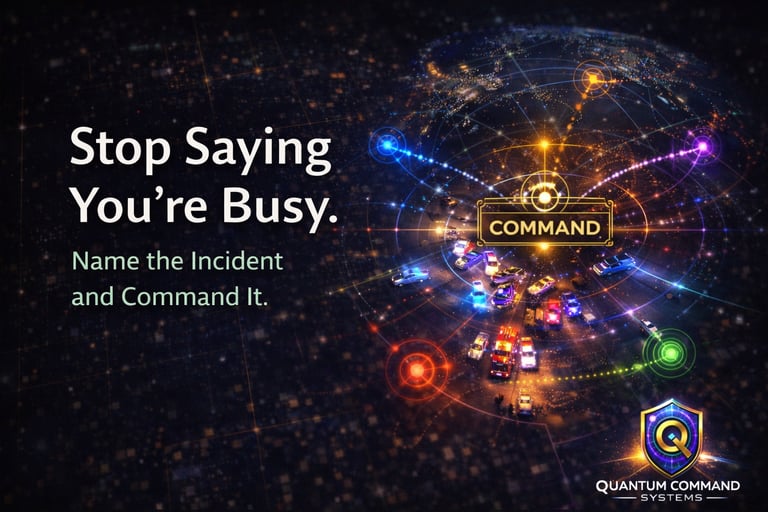
Stop Saying You're Busy. Name the Incident and Command It.
Your life isn't chaotic—it's an unmanaged incident. Learn the 60-Second Civilian Size-Up to take command of any day, fast.
Michael E. Smith, Jr.
3/2/20267 min read
Quantum Command Systems | March 2, 2026
Stop Saying You're Busy. Name the Incident and Command It.
Leadership Operations • 8 min read
The tones drop at 0214 hours.
The dispatcher gives you a structure fire — residential, two stories, unknown occupants. Smoke showing from the second floor, visible from the street. Your engine is the first unit on scene.
You have thirty seconds before your crew needs direction.
Here's what you don't do: panic. Run. Wing it. Scroll through options. Tell people you're "really busy."
Here's what you do: Size it up. Name it. Command it.
You identify the structure, read the smoke, confirm your water supply, declare command, and issue the first assignment. Within ninety seconds, you've established a system for an evolving, potentially deadly situation — before you have complete information.
Now. Think about your Tuesday.
The project overdue. The inbox bleeding out. The kid's school calling at 8:47 a.m. The meeting you weren't prepared for. The afternoon that became a blur.
That wasn't a bad day. That was an unmanaged incident.
And the reason it keeps happening isn't your schedule. It's that you've never declared command of your own life.
Action
The Problem Isn't Chaos. It's the Absence of Command.
Every firefighter knows this truth: the fire is not the emergency. The lack of a system is.
A structure fire is violent, unpredictable, and expensive in every currency — time, property, lives. And yet, across thousands of incidents in thousands of jurisdictions, trained crews manage them. Not because fire becomes predictable. Because commanders stop reacting and start operating.
Your life is running the same call.
Picture this: It's 7:22 a.m. on a Wednesday. You're a business owner with a team of six, two kids, and a quarterly report due Friday. Your phone already has eleven notifications. Your spouse needs you to handle something at the house before noon. You haven't touched your priorities list since Sunday. You opened your laptop — but you're not sure what you're actually working toward today.
That's not a productivity problem. That's an incident without a commander.
The hidden cost is not the lost hour. It's the compounded drift.
Every day you operate without command costs you something. The client relationship that went cold because you couldn't follow through consistently. The health routine that collapsed under reaction. The team that stopped trusting your direction because your direction kept changing. The family that got your leftovers instead of your leadership.
Drift is not dramatic. It doesn't announce itself. It just quietly takes what you don't defend.
Reflection
Why Smart, Driven People Lose Command
You're not lazy. You're not weak. You may be one of the hardest-working people in the room.
And you are still losing ground. Here's why:
Trap 1: Busy ≠ Effective.
Activity is not output. Movement is not momentum. You can work fourteen hours and end the day further from your mission than when you started. The firefighter analogy: running into a burning building without a plan doesn't make you brave — it makes you a victim. Controlled aggression with a clear objective is what creates outcomes.
Trap 2: Information ≠ Command.
You have more data about your life than any generation before you. Productivity apps, habit trackers, calendar systems. And you're still overwhelmed. Why? Because information without a command structure is just noise with a premium subscription. A captain doesn't win the fire by knowing more about fire. They win by deciding and directing based on what they know.
Trap 3: Emotion ≠ Directive.
Anxiety, frustration, urgency — these are your body's way of flagging that you've lost command. They are not operational inputs. On an incident, emotion that overtakes your decision-making costs lives. In your life, it costs months. High performers who confuse how they feel with what they should do next will always be reactive operators in a world that rewards command.
Principle
The Law of Command Clarity
The system that manages the incident determines the outcome — not the severity of the incident.
Your life's outcomes are not determined by how hard it is. They are determined by whether or not you have a command structure running it.
The Quantum Command Systems Life-Incident Framework
Eight Operational Positions for Daily Command
1. Command
Who is responsible for the overall outcome?
That's you. Not your calendar app. Not your team. Not circumstances. You have declared command of this operational period — your day, your week, your quarter. Every position below you flows from this declaration. If command is vacant, the incident runs you.
2. Planning
What is the plan for this operational period?
Before execution, there is deliberate thought. What does success look like at the end of this day? What are the priorities, the sequence, and the contingencies? Planning is not overthinking — it's command intelligence translated into direction. Without it, Operations is just controlled chaos.
3. Operations
What are we actively working on and in what sequence?
Your top three priority assignments for the day. Nothing more. Sequenced. Time-blocked. Non-negotiable unless conditions change and Command decides to pivot. Operations answers one question: What are we doing right now?
4. Logistics
What do I need and do I have it?
Energy, time, support, information, tools. If any of these are missing before execution begins, you don't fight the fire — you call for resources first. You don't white-knuckle through a day running on empty. Logistics is not weakness. It is operational professionalism.
5. Finance / Admin
What does this cost and is it accounted for?
Every decision has a cost — time, money, attention, relationship capital. The commander who doesn't track the cost of operations eventually runs out of capacity. In your life, this position asks: Am I spending my resources in alignment with my mission, or leaking them into low-return activity?
6. Safety
What am I protecting at all costs?
Your health. Your family's trust. Your integrity. Your rest. These are non-negotiables that never get traded for urgency. On an incident, the Safety Officer has authority to stop operations. In your life, this position holds the same rank. When safety collapses, everything else follows.
7. PIO — Public Information Officer
What am I communicating and to whom?
Your team, your family, your clients, your community — they need accurate, timely information from their commander. The leader who goes silent under pressure loses trust faster than the leader who makes a mistake. PIO asks: Am I communicating with clarity, consistency, and command presence — or am I going dark when things get hard?
8. Liaison
Who am I coordinating with outside my immediate command?
No commander operates in isolation. Mentors, partners, advisors, peers, your faith community — these are your agency representatives. Liaison keeps those relationships active and operational. The isolated commander is the most dangerous commander.
Command Decision
"Today, I choose to stop describing my day as 'busy' and start running it as an incident with a commander. I am that commander."
Activation
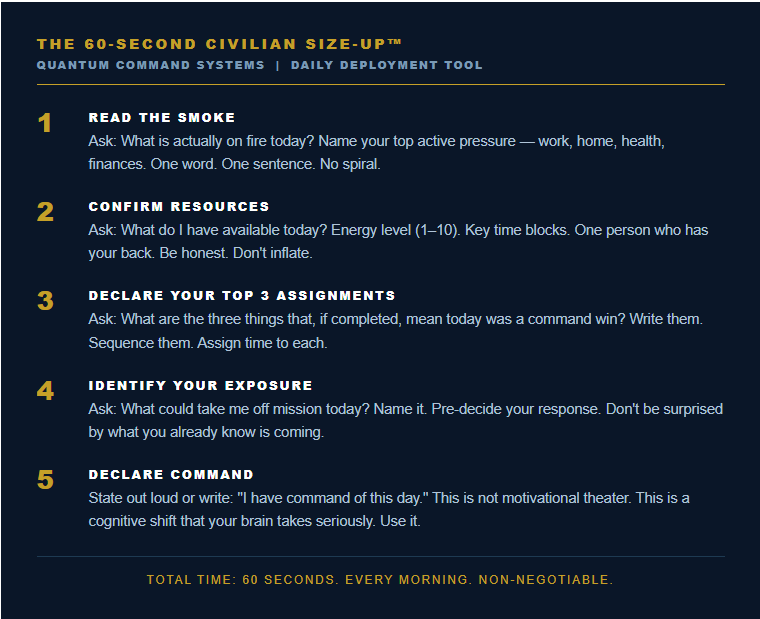
The 60-Second Civilian Size-Up™
This is your field tool. Deployable every morning in under sixty seconds. No journal required. No app. No lengthy planning session. Just a quick operational read — the same way a company officer sizes up a scene before anyone gets off the rig.
Today Deployment — 10-Minute Sequence
Minute 1 — Grab a notepad or open a blank document. No phone.
Minutes 2–3 — Run the 60-Second Civilian Size-Up on today. Right now.
Minutes 4–6 — Write your three operational assignments for today with a start time next to each.
Minutes 7–8 — Identify your top exposure. Pre-decide your response before the pressure arrives.
Minutes 9–10 — Declare command. Say the line. Then go. Don't revisit, don't re-plan. Execute.
7-Day Micro-Commitment ChallengeRun the 60-Second Civilian Size-Up every morning for seven consecutive days — before you check your phone, open email, or speak to anyone. At the end of Day 7, look back at your notes. You will have generated the clearest operational picture of your own life you've ever seen. The patterns will be undeniable. The leverage points will be obvious. The drift will be named.
This is how command begins — not with a dramatic overhaul, but with seven days of deliberate sizing up.
Join the Community
The Quantum Commander Community is built for people who are done describing their chaos and ready to command it.
If you run a business, lead a team, serve a department, or manage a household with any level of intensity — you belong here. Inside the community and on the weekly brief, you'll get the Quantum Command framework applied to real operational challenges, field tools you can deploy immediately, and access to resources that don't exist in mainstream leadership circles.
This is not a motivation page. It's a command post.
→ Join the Quantum Commander Community
→ Get the WEEKLY BLOG + Free Starter Resource
Mastermind & Coaching
Ready to stop reading and start building?
The Quantum Commander Mastermind is open to a small cohort of operators who want to install the full system — not just the concept. This is precision work. It's not for everyone. It's for the person who already knows they're operating below their command capacity and is ready to close that gap with structure, accountability, and a framework forged in fire — literally.
Applications for the next cohort are open.
You were made for more than managed chaos.
Whether you serve in a station, run a company, lead a family, or all three — the call is the same. Life is the incident. It doesn't wait for you to feel ready. It doesn't organize itself because you're a good person or a hard worker. It responds to command.
The moment you stop calling your life "busy" and start treating it as an incident under your command — everything shifts. Not because the circumstances change. Because you change. The commander is on scene. And the commander has a plan.
Proverbs 16:3 — "Commit your plans to the Lord, and your purposes will be established." That's not passive. That's a commander aligning his mission with something greater than himself, and then moving.
Take the command. Hold the command.
This is your operational life. Run it accordingly.
Mike
— Quantum Command Systems
Connect
Questions? Reach out anytime for support.
Email:
support@thequantumcommander.com
© 2025. All rights reserved.