establish command today!

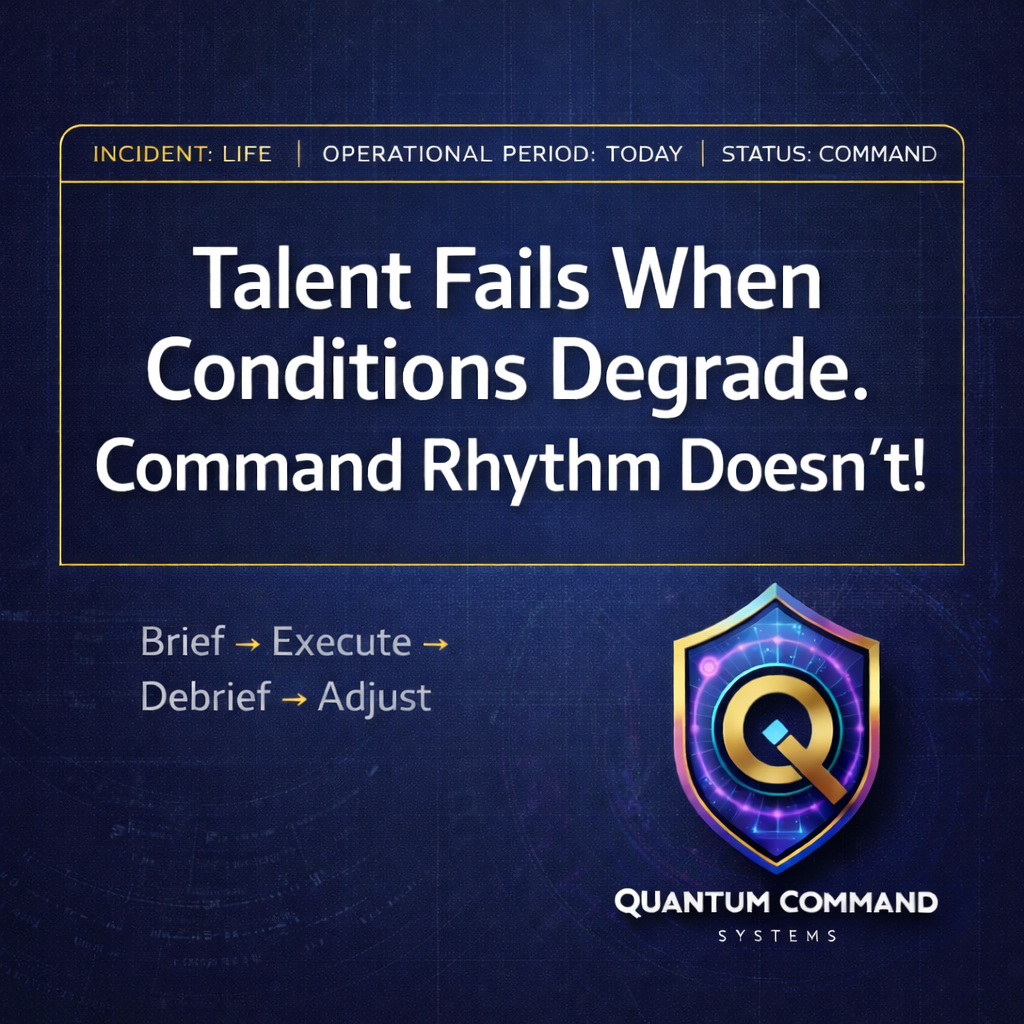
Talent Fails When Conditions Degrade. Command Rhythm Doesn't!
Stop chasing your best day. Elite Commanders don't optimize peak performance—they build floors that hold when everything degrades. Here's the operational system talent can't replace.
Michael E. Smith, Jr.
2/9/20265 min read
Your Best Operational Period Means Nothing If You Can't Repeat It.
You ran a perfect Tuesday.
Closed the six-figure deal. Solved the operational crisis. Led the high-stakes briefing with precision. Your team saw command presence. You felt it.
Then Thursday arrives and you can barely answer email.
This isn't imposter syndrome. It's structural failure.
Talent without rhythm collapses under pressure. Command without a system is reactive chaos. And neither builds freedom.
Here's the operational reality: Your empire isn't measured by your peak performance. It's measured by your ability to hold the line when conditions degrade.
THE SUPERSTAR TRAP
Most high performers operate in two states:
Command Mode: Deep focus. Flawless execution. Decisions aligned to mission. You're running the incident.
Survival Mode: Reactive drift. Decision fatigue. Output drops to 30%. You're managing fires instead of establishing Command.
The problem isn't capacity. It's architecture.
You're running on inspiration instead of infrastructure. Adrenaline instead of rhythm. Peak state instead of repeatable protocol.
And when conditions shift—stress, travel, interruption, sleep deprivation—your performance collapses because there's no foundation holding it.
Real incident:
A CEO I worked with generated $2.3M in Q1. Exceptional quarter. The kind of outcome that creates board confidence and competitive fear.
Q2? $840K.
Same market. Same team. Same raw talent.
What changed? He had no Internal ICS. His Q1 win came from a 72-hour hyperfocus sprint fueled by adrenaline and desperation. It worked once. It couldn't repeat.
By Q3, his team stopped trusting his command presence. Clients delayed contracts. He was bleeding credibility because no one—including him—knew which version would show up to the operational period.
Talent opened the door. Inconsistent execution destroyed the freedom architecture.
WHY DISCIPLINED OPERATORS STILL FALL INTO REACTIVE DRIFT
You know rhythm matters. Every leadership system preaches it.
So why do intelligent, high-performing operators still fall into erratic execution?
Three failure modes:
Failure Mode 1: Busy ≠ Aligned
You confuse activity with mission. A packed calendar feels productive. But if your peak performance requires perfect conditions, you're not commanding—you're lucky.
Failure Mode 2: Inspiration ≠ Command
You wait for clarity to arrive. For motivation to return. For 'the zone' to show up. Meanwhile, disciplined operators are executing MyCS 200 whether they feel like it or not.
Failure Mode 3: Willpower ≠ Structure
You think discipline is forcing yourself harder. It's not. Discipline is reducing decisions. It's pre-loading execution so performance doesn't depend on your frequency state.
Elite Commanders don't rely on peak conditions. They build floors so Command holds even when conditions degrade.
THE COMMAND RHYTHM PRINCIPLE
Core Law:
Sustainable freedom is a function of repeatable structure, not exceptional talent.
Talent is your ceiling. Command rhythm is your foundation. And foundations determine how much freedom you can engineer.
The operators who dominate long-term don't outwork everyone. They out-system everyone.
Here's the framework:
THE INTERNAL ICS: 4-DIVISION COMMAND RHYTHM
This is how you build a Command structure that operates regardless of conditions.
OPERATIONS: Daily Command Sequence
Your Operations Section executes the mission. In civilian life, that's your Daily Command Sequence—the non-negotiable rhythm that maintains Command regardless of conditions.
Core protocol:
MyCS 200 (Morning Briefing): Set Command Intent, identify today's objectives, establish operational priorities
MyCS 214 (Evening Debrief): Close loops, assess execution, adjust for next operational period
These run regardless of conditions. Degraded state? Travel? Crisis? The briefing still happens—even at Minimum Viable Deposit (MVD).
PLANNING: Pre-Loaded Decision Architecture
Your Planning Section removes real-time decisions. Decision fatigue kills rhythm. Every choice you make in the moment drains energy and increases variance.
Build protocols that eliminate decisions:
Morning sequence: Same start. Same first three actions. No debate.
Communication protocols: When you respond. How you respond. What gets ignored.
Energy management: When you do deep work. When you take calls. When you restore.
Protocols turn performance into procedure. You're not 'finding motivation.' You're following the SOP.
LOGISTICS: MVD (Minimum Viable Deposit)
Your Logistics Section maintains supply lines when conditions degrade. In Command terms, that's your Minimum Viable Deposit—the floor you never drop below.
When you cannot run the full protocol, you don't quit. You downshift.
Your MVD is the smallest daily deposit that keeps Command online. Choose ONE and hold it for 7 days:
MyCS 200 briefing (even if 5 minutes)
10-minute walk
15 minutes of aligned learning
5-minute environment reset
The mission is continuity, not perfection.
FINANCE/ADMIN: Visible Accountability (Commander KPIs)
Your Finance/Admin Section tracks resources and maintains accountability. You can't command what you don't measure.
Track two KPIs:
Command Continuity: Did MyCS 200 and MyCS 214 happen? (Yes/No — no grades)
4% Protocol Completion: How many of the four daily deposits executed? (0/4 → 4/4)
Not outcomes. Not revenue. Not feelings.
Just: Did you execute the structure?
When Command Continuity stays above 80% for 30 days, your floor rises. When 4% completion holds at 3/4 or better for 21 days, you've installed a new baseline.
THE COMMANDER'S DECISION
You face a choice today:
Option A: Keep chasing peak performance. Rely on talent. Hope for perfect conditions. Live in the variance between superstar and survival.
Option B: Establish the Internal ICS. Install Command rhythm. Execute the Daily Command Sequence. Become operationally excellent.
Talent makes highlight reels.
Command rhythm builds freedom.
Which are you choosing?
TODAY DEPLOYMENT (10-Minute Command Post Setup)
Step 1 (3 minutes): Establish your physical Command Post.
Choose the location where you'll run your Daily Command Sequence. Same place every day.
Examples: Kitchen table at 0500 | Home office | Parked car | Coffee shop corner
Requirements:
Consistent (same place daily)
Quiet (no interruptions during briefing)
Equipped (MyCS forms, pen, timer)
Step 2 (2 minutes): Define your MVD.
Choose ONE action that, even on degraded days, you will execute to maintain Command continuity:
MyCS 200 briefing (even 5 minutes)
10-minute walk
15 minutes aligned learning
5-minute environment reset
Step 3 (3 minutes): Install your tracker.
Download or create a simple grid:
DATE | MyCS 200 | MyCS 214 | 4% Score (0-4) | Command Continuity (✓/✗)
Track for 7 days. No analysis. No judgment. Just visibility.
Step 4 (2 minutes): Set your entry protocol.
How do you enter Command mode each morning?
The 10-Second Entry Protocol:
Sit down at Command Post
Three deep breaths
Say internally: 'The Command Post is open'
Begin MyCS 200
Lock it in. The protocol becomes automatic.
7-DAY COMMAND INSTALLATION
For the next 7 days, run your Daily Command Sequence.
That's it.
MyCS 200 (morning)
MyCS 214 (evening)
At least 1 MVD if conditions degrade
No stretch goals. No bonus tasks. No 'might as well also...'
Just the rhythm.
By day 7, you'll have data. You'll know where the structure holds. You'll see where it breaks.
Then you adjust.
DM 'FREEDOM' to share your Command Continuity streak.
Want to measure where your freedom architecture is breaking?
The Freedom Audit quantifies your operational gaps across the 7 Freedom Domains:
D1: Time Architecture & Command Rhythm
D2: Decision Velocity & Alignment
D3: Energy & Recovery Cycles
D4: Financial Autonomy & Resourcefulness
D5: Relational Boundaries & Unified Command
D6: Delegation & Team Leverage
D7: Environmental Command & Digital Boundaries
You receive:
Your Freedom Score (0-100)
Primary Freedom Profile (where you're bleeding freedom)
Tool-stack prescriptions mapped to your gaps
This is the diagnostic that shows you exactly where structure is missing—and how to install it.
Next step: DM 'FREEDOM' to request your Freedom Audit.
CLOSING
Talent opens Command Posts.
Rhythm keeps them operational.
Your competition is betting on genius. You're installing Internal ICS. When their inspiration runs dry, your Command structure keeps executing.
This is how freedom scales. This is how operators compound. This is how you take Command before chaos does.
The decision was always yours.
Establish Command. Execute the rhythm. Take the Command Post.
Mike
— Quantum Command Systems
Connect
Questions? Reach out anytime for support.
Email:
support@thequantumcommander.com
© 2025. All rights reserved.